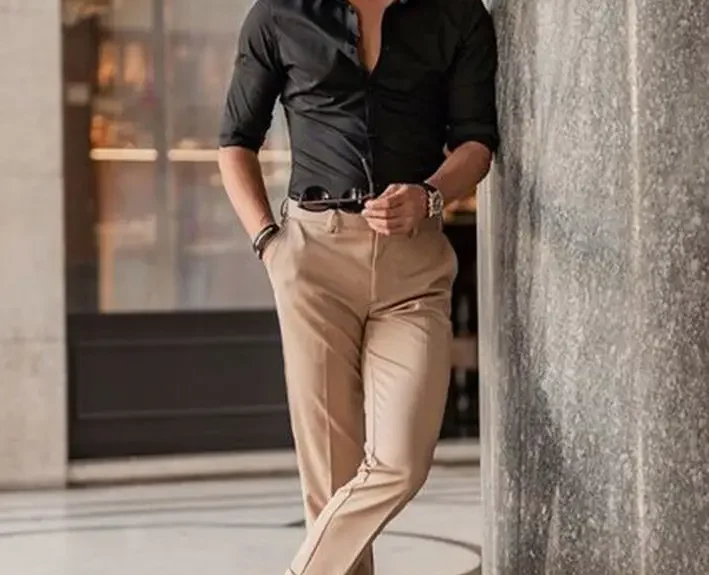

Rolling up your sleeves should feel like second nature. It is the universal gesture for getting down to work, shaking off formality at the end of the day, or simply staying cool as the temperature climbs. Yet most people approach the task without a second thought, flipping the cuff over itself like an accordion until their forearm is pinched by a thick, sausage-like doughnut of bunched fabric.
Within an hour, that clumsy roll begins to sag. You bend your arm to check your watch or reach across your desk, and the fabric binds against your elbow, cutting off circulation. Five minutes later, one sleeve is pooling around your wrist while the other is crookedly trapped halfway up your forearm.
There is a significantly better approach. Known across traditional menswear tailoring as the Master Roll—and frequently referred to as the Italian roll—this method is the cleanest, most secure, and most visually balanced way to roll up a button-down shirt. Once you understand the mechanics behind it, you will never roll your sleeves any other way.
Why Most Sleeve Rolls Fail
To understand why the Master Roll works so well, it helps to examine why the traditional rolling method falls short.
The most common technique is the basic flip roll: unbuttoning the cuff, turning it back once, and then folding it over itself two or three times in identical increments. While intuitive, this approach works against the natural geometry of both your arm and your shirt.
A dress shirt or casual button-down sleeve is tapered. It is narrower at the wrist and wider at the elbow and bicep. When you roll the narrow fabric of the cuff upward in repeated short folds, you force smaller diameters of fabric over progressively thicker parts of your arm. The resulting roll becomes rigid, bulky, and tight.
Because the basic roll relies solely on the friction between identical folds, any sudden flex of the forearm muscles forces the folds apart. The roll slowly works itself loose, leaving the fabric wrinkled, stretched, and sloppy. The Master Roll eliminates this problem by using a structural anchor fold that locks the entire sleeve in place with minimal bulk.
The Advantages of the Master Roll
The Master Roll is more than just an aesthetic trick; it is an exercise in functional garment design. It provides several clear advantages over every other method.
First and foremost is unmatched stability. Because the final step covers the seam and wraps around the main fold, the sleeve will not unroll throughout the day, even if you are moving boxes, typing at a desk, or driving.
Second is freedom of movement. The Master Roll creates a flat, low-profile band rather than a dense bundle of fabric. This leaves your elbow joint free to bend without tension or pinched skin.
Third is ease of undoing. While a traditional roll has to be unpicked layer by layer, unspooling the Master Roll takes a single second. You simply grasp the exposed tip of the cuff and pull downward. The entire roll releases instantly in a single, fluid motion, leaving behind far fewer severe wrinkles than repetitive folding.
Finally, the Master Roll offers effortless visual polish. If your shirt features a contrasting fabric pattern, color, or lining on the inside of the cuff—a common detail in modern shirting—this technique displays a clean sliver of that inner fabric, adding a sharp, deliberate accent to your outfit.
Anatomy of the Sleeve: What to Check First
Before you start folding, you need to understand the construction of your shirt sleeve. Many sleeve rolls fail before they even start because the wearer forgets one critical detail: the buttons.
Every standard long-sleeve button-down features two distinct button zones on the sleeve:
-
The Cuff Button: The primary closure that secures the cuff around your wrist.
-
The Gauntlet Button: The smaller button located higher up the sleeve, set inside the placket opening.
You must unbutton both buttons. Leaving the gauntlet button fastened restricts the sleeve placket from opening fully. When the placket cannot expand, you cannot pull the sleeve high enough up your arm without straining the stitching and choking your forearm. Unfastening both buttons allows the sleeve to flare open naturally, providing the necessary slack for a smooth, flat roll.
How to Execute the Master Roll
The technique takes less than ten seconds once your hands learn the motion. Stand comfortably and keep the sleeve pulled straight down against your arm before you begin.
Step 1: Prep and Unfasten
Unbutton the cuff button and the gauntlet button on the sleeve placket. Smooth out any major twists in the fabric so the sleeve hangs naturally along your arm.
Step 2: The Anchor Draw
Turn the cuff inside-out and pull it straight up your arm in one long, decisive motion. Do not fold it incrementally. Pull the cuff upward until the bottom edge sits roughly two inches above your elbow, or just below it if you prefer a lower forearm sit. The sleeve will now be inverted inside-out along your lower arm, with the cuff resting higher than your target finished height.
Step 3: The Fold and Lock
Take the bottom edge of the inside-out sleeve fabric (the fold that formed near your wrist or lower forearm) and fold it upward, rolling it over itself toward the inverted cuff. Continue pulling this fold up until it covers the bottom of the cuff.
Step 4: The Final Reveal
Here is the crucial signature of the Master Roll: do not cover the cuff entirely. Leave roughly a quarter-inch to a half-inch of the top edge of the cuff peeking out above your fold. This exposed edge acts as the structural lock that anchors the roll, while also presenting a clean, intentional finish. Smooth down the edges with your hands to remove any stray creases.
To reverse the roll at the end of the day, simply take hold of the exposed edge of the cuff and pull straight down toward your hand. The entire structure will fall cleanly back into place.
Finding the Right Height and Balance
Where your roll should sit depends on what you are doing, the cut of your shirt, and your personal build.
If you are wearing a dress shirt in a professional or business-casual setting, the roll should typically sit just below the elbow. This position signals relaxed confidence while preserving a clean, structured appearance. It flatters almost every arm shape, keeps the cuff clear of desk surfaces, and prevents the roll from bunching into the crook of your elbow.
If you are doing physical work, working in the heat, or wearing a rugged casual shirt like chambray or denim, pulling the roll just above the elbow is completely acceptable. The key is to ensure the roll sits cleanly on the lower portion of the bicep rather than resting directly on the elbow bone, which can feel uncomfortable during repetitive arm movement.
Adjusting for Different Fabrics
Not every shirt fabric behaves the same way when folded. The Master Roll works across virtually all weaves, but slight adjustments help optimize the look and hold.
-
Broadcloth and Poplin: These classic dress shirt fabrics are smooth, crisp, and relatively thin. Because they have less surface friction, be sure your final lock fold covers enough of the cuff to hold the slick cotton firmly in place.
-
Oxford Cloth (OCBD): The heavier, basket-weave texture of Oxford cotton is ideally suited for the Master Roll. It possesses enough body and natural grip to hold its shape indefinitely without slipping.
-
Linen: Pure linen stretches and shifts as the day progresses. When rolling linen, keep the folds slightly looser to allow the breezy, relaxed character of the fabric to show through without over-stressing the weave.
-
Flannel and Heavy Twill: Heavy winter fabrics can become overly bulky if folded too many times. The Master Roll is particularly valuable here because it requires fewer layers of folded material than standard rolling methods, keeping the profile clean and manageable.
Small sartorial details rarely require significant effort, but they consistently define how put-together you appear. The Master Roll takes something as mundane as rolling up your sleeves and transforms it into a deliberate, functional habit that stays locked, feels comfortable, and looks sharp from morning until night.